Delcy Rodríguez Tells Miami Investors Venezuela Will Protect Contracts as Oil Sector Opens to Private Capital
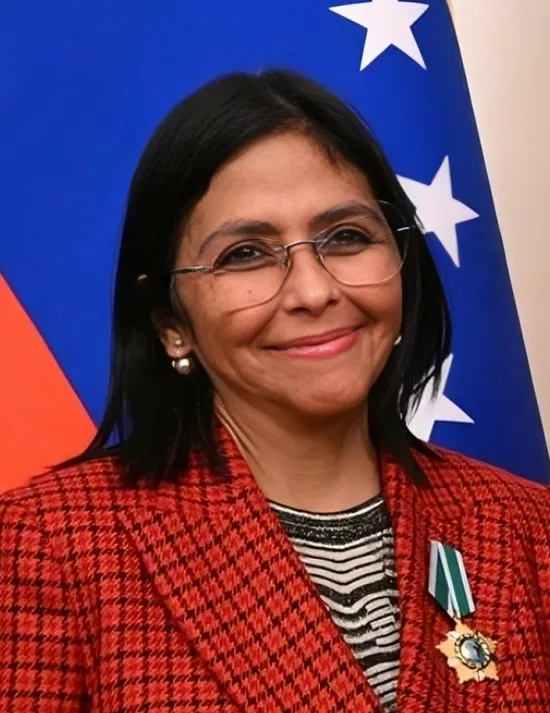
Venezuela’s interim leader outlines investor safeguards and sector reforms in a Miami appearance
Venezuela’s acting president, Delcy Rodríguez, used a Miami investment forum on Wednesday, March 25, 2026, to invite U.S. and international capital back into a country that for years treated American investment—particularly in oil—as politically toxic. Rodríguez participated by videoconference from Caracas at FII Priority, a meeting hosted in Miami Beach and backed by Saudi Arabia’s sovereign wealth fund.
Her message focused on legal predictability for investors and on changes to Venezuela’s hydrocarbons policy that the government says are intended to rebuild output and attract long-term financing. The pitch comes amid a rapid shift in Venezuela’s governance and energy framework since early January, following the U.S. military capture of former president Nicolás Maduro and the launch of a U.S.-backed plan to restructure Venezuela’s sanctioned oil sector.
What Rodríguez promised investors
Rodríguez emphasized what she described as “legal certainty” for investment, including protections she said would apply regardless of political alternation. In her remarks, she presented Venezuela as moving toward a rules-based environment where investors can expect enforceable laws and credible pathways to recover capital and returns.
She also argued that reforms are not limited to hydrocarbons, highlighting other sectors she said are showing growth or are targeted for investment, including construction, banking, insurance, mining, and manufacturing. The government’s broader objective, as framed in the forum, is to diversify sources of growth while using energy reform as a cornerstone for stabilization.
Key reforms highlighted in the pitch
- Opening the oil industry to greater participation by private and foreign capital.
- Expanded acceptance of international arbitration mechanisms for disputes.
- Increased external scrutiny and oversight designed to improve investor confidence.
Rodríguez presented these changes as a break from prior restrictions that limited investment and contributed to underinvestment and operational decline across the energy sector.
Political and market context shaping the appeal
The Miami appearance was also a signal to U.S. markets at a time when the United States has been reshaping its relationship with Caracas and asserting oversight over aspects of Venezuela’s future oil-export revenue. The shift has raised questions among investors about governance durability, contract enforcement, and the practical implementation of new rules inside an industry historically dominated by the state.
Rodríguez’s investor outreach unfolded alongside competing efforts by opposition leader María Corina Machado, who has separately courted energy investors and promoted the creation of an independent hydrocarbons regulator. That parallel messaging underscores that, while the policy direction is being marketed as investor-friendly, the political trajectory—and the long-term institutional design that would underpin energy contracts—remains central to investor risk assessments.
Rodríguez’s Miami remarks placed legal stability and dispute-resolution credibility at the center of Venezuela’s investment case, with oil-sector reform positioned as the main entry point for broader economic reactivation.