Trump’s Shield of the Americas Summit in Miami launches new anti-cartel coalition amid Iran conflict fallout
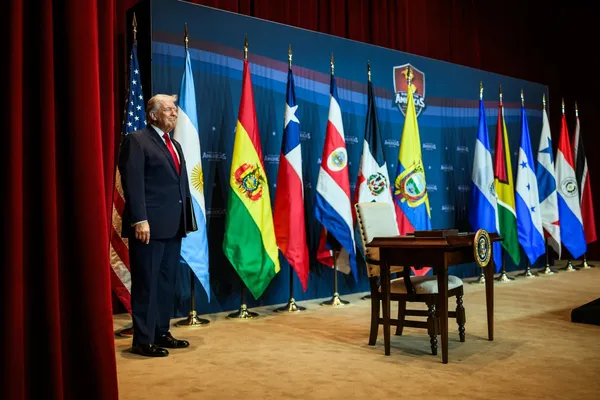
A hemispheric security meeting in South Florida
President Donald Trump convened the Shield of the Americas summit on March 7, 2026, at Trump National Doral Miami in Doral, bringing together heads of government from across Latin America and the Caribbean for a one-day meeting centered on regional security and organized crime.
Leaders in attendance included the presidents of Argentina, Bolivia, Chile, Costa Rica, the Dominican Republic, Ecuador, El Salvador, Guyana, Honduras, Panama, Paraguay, and Trinidad and Tobago. Mexico and Brazil—the region’s largest Spanish- and Portuguese-speaking powers—did not participate, and Colombia was also absent.
What was announced: an Americas Counter-Cartel Coalition
The summit’s central deliverable was a U.S. proclamation launching what the administration described as an Americas Counter-Cartel Coalition, framed as a mechanism for expanded intelligence sharing, coordination among security services, and joint operations aimed at disrupting cartel leadership, logistics, and financing. U.S. officials characterized the coalition as multinational and operationally focused, with participating states expected to align policies on counter-narcotics and related transnational threats.
In public remarks, Trump argued that cartel violence and drug trafficking require a stronger regional security response, including the use of military capabilities in support of law-enforcement objectives. The White House presented the initiative as part of a broader “America First” approach to the Western Hemisphere, linking security cooperation to migration enforcement and to limiting the strategic influence of external powers in the region.
Iran and Venezuela formed the backdrop to the Miami gathering
The Miami summit unfolded amid heightened international tension following the U.S. and Israel’s recent military campaign against Iran, a conflict that has generated significant global uncertainty and market volatility. Trump referenced the Iran operation while shifting the day’s focus toward hemispheric issues and domestic security priorities.
The meeting also came roughly two months after a U.S. operation in Venezuela that resulted in the capture of Nicolás Maduro and his wife, Cilia Flores, who were transferred to the United States and faced federal drug-related charges in New York. That episode elevated the administration’s emphasis on using military assets in support of cross-border law-enforcement actions.
Key questions now: participation, rules, and oversight
Beyond the summit’s announcements, several practical issues remain central to assessing the initiative’s impact:
Which countries will formally join and what commitments will be codified in writing.
How joint operations would be authorized, led, and bounded by domestic and international law.
What safeguards will govern intelligence sharing, targeting standards, and accountability for security forces.
How the initiative will interact with existing regional structures and long-running bilateral counter-narcotics programs.
The summit’s stated objective was to accelerate coordinated action against cartels while tightening cooperation on border security and broader transnational threats.
With major regional players absent and operational details still emerging, the coalition’s durability will likely depend on whether participating governments translate political alignment into sustained, measurable security cooperation.